



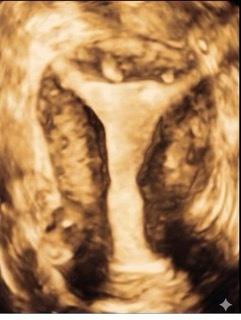
Adenomyosis is often reduced to “heavy and painful periods”. In practice, it is a complex uterine disorder involving structural changes, hormonal signalling, inflammation and vascular activity, with variable effects on pain, bleeding and fertility.
This explains why patients present very differently — and why standard, uniform treatment pathways often fail.
Why I use a structured approach
In many cases, management becomes:
- repeated hormonal changes
- trial-and-error treatment
- delayed or unclear fertility decisions
This is not due to lack of options, but lack of structure.
My approach is therefore built around a defined clinical framework (STRATA) to organise complexity and guide decision-making.
Step 1: Deep diagnostic mapping
The starting point is not simply confirming adenomyosis, but defining its architecture and behaviour.
This includes:
- detailed clinical history (bleeding pattern, pain, reproductive history)
- advanced transvaginal ultrasound (including junctional zone assessment where relevant)
- MRI in selected cases for complex mapping or fertility planning
The aim is to define:
- focal vs diffuse disease
- depth and distribution
- coexisting pathology (fibroids, endometriosis)
- likely impact on symptoms and fertility
Step 2: Aligning with reproductive intent
Management is always built around:
- symptom burden
- disease pattern
- reproductive goals
These may include:
- symptom control only
- active fertility planning
- fertility preservation
This alignment is essential. Without it, treatment decisions are often inconsistent or inappropriate.
Step 3: A layered treatment architecture
Treatment is not a single intervention, but a structured sequence.
Hormonal layer
Used where appropriate to control bleeding and pain or modulate disease activity:
- LNG-IUS
- oral progestins
- short-term GnRH-based suppression in selected cases
These are used within a defined plan, not indefinitely.
Structural consideration (external referral where appropriate)
In some patients, particularly with significant disease burden, structural intervention may be relevant.
This may include uterus-preserving options such as:
- focused ultrasound
- embolisation
- or conservative surgical approaches
Where appropriate, patients are guided towards specialist centres for these options.
Integrative layer (system-level modulation)
Adenomyosis is not purely structural.
Within a structured plan, I also assess:
- inflammatory activity
- vascular function
- metabolic influences
- pain processing
Targeted adjunctive strategies may be used to support:
- symptom control
- treatment response
- and endometrial environment
These are always:
- evidence-informed
- time-bound
- and monitored against objective outcomes
Step 4: Fertility strategy is integrated from the start
Adenomyosis can affect implantation and pregnancy outcomes.
For women planning pregnancy:
- imaging findings are used to assess risk
- pre-conception optimisation may be required
- timing of fertility treatment is planned strategically
Where IVF is involved, structured preparation may improve outcomes.
Step 5: A defined 6–12 month plan
Management is not open-ended.
A typical pathway includes:
- baseline assessment (symptoms + imaging)
- a staged plan over 6–12 months
- predefined checkpoints
- clear criteria for response or change in strategy
This replaces:
- fragmented care
- repeated short-term trials
- delayed escalation
What this approach changes
Instead of:
- uncertainty
- repeated treatment changes
- or late decisions
Patients receive:
- structured understanding
- prioritised actions
- and a clear clinical direction
Conclusion
Adenomyosis requires more than symptom control.
It requires structured assessment, integrative thinking, and precise timing of interventions.
For a full explanation of my structured approach, including diagnostic mapping and treatment planning, see:
https://strata.vpb-fertility.com
If symptoms persist or decisions remain unclear, a structured assessment can help define the most appropriate next steps.
https://strata.vpb-fertility.com
If symptoms persist or decisions remain unclear, a structured assessment can help define the most appropriate next steps.