

Manage cookies
We use cookies to provide the best site experience.
Manage cookies
Cookie Settings
Cookies necessary for the correct operation of the site are always enabled.
Other cookies are configurable.
Essential cookies
Always On. These cookies are essential so that you can use the website and use its functions. They cannot be turned off. They're set in response to requests made by you, such as setting your privacy preferences, logging in or filling in forms.
Analytics cookies
Disabled
These cookies collect information to help us understand how our Websites are being used or how effective our marketing campaigns are, or to help us customise our Websites for you. See a list of the analytics cookies we use here.
Advertising cookies
Disabled
These cookies provide advertising companies with information about your online activity to help them deliver more relevant online advertising to you or to limit how many times you see an ad. This information may be shared with other advertising companies. See a list of the advertising cookies we use here.

Consultant-Led Adenomyosis, Endometriosis & Fertility Strategy

Many women arrive after years of heavy periods, pelvic pain, or fertility uncertainty — having tried multiple treatments without a clear plan or a coherent explanation.
This practice offers something different: a structured clinical assessment that identifies what is actually driving your condition, and a plan that follows from it.
Advanced diagnostics. Consultant-performed ultrasound. Integrative clinical reasoning. In-person in Manchester and online across the UK. Consultations in English and Russian.

This practice is designed for
women who have complex symptoms,
have usually tried more than one approach,
and are ready to understand the full picture — not just manage the next symptom.
  • Persistent or worsening adenomyosis or endometriosis
  • Heavy bleeding, pelvic pain, or symptoms that have not responded fully to treatment
  • Fertility concerns — current or future — that need a coherent plan
  • Recurrent miscarriage or implantation failure without a clear explanation
  • A sense that something is being missed, but not knowing what
STRATA Clinical Framework™
The STRATA Clinical Framework is a structured assessment approach developed by Dr Ksenia Alex. It evaluates each case across six layers — structure, timing, reproductive intent, activity, terrain, and action — to produce a complete clinical picture and a sequenced plan.
Available in person in Manchester and online across the UK. Consultations in English and Russian.
For women with complex adenomyosis or gynaecological conditions where standard approaches have not provided clarity or resolution.

Who this practice is for

  • Heavy, irregular, or painful periods
  • Chronic pelvic pain or persistent, unexplained symptoms
  • Suspected or confirmed endometriosis or adenomyosis
  • Recurrent miscarriage or recurrent implantation failure
  • Subfertility and fertility investigations
  • Fertility planning where adenomyosis or endometriosis is part of the picture
  • Symptoms that have not fully resolved despite previous treatment
  • Perimenopause with complex or unresolved gynaecological symptoms
  • PCOS, thyroid disorders, and hormonal imbalance

Specialist Services — Manchester and Online

  • Endometriosis, Adenomyosis & Pelvic Pain
    • Consultant-performed ultrasound mapping for endometriosis and adenomyosis
    • Structured assessment and early diagnosis
    • Surgical guidance and referral where indicated
    • Symptom-led management with integrative options where appropriate
  • Fertility Assessment & Planning
    • Consultant-led fertility investigations
    • Adenomyosis and endometriosis impact on fertility — assessment and planning
    • Hormone, thyroid, and metabolic optimisation
    • Recurrent miscarriage and implantation failure evaluation
    • Structured plan before, during, or instead of IVF
    • Fertility is not always the primary concern — but it is always considered as part of the clinical picture, including in women approaching perimenopause.
  • Integrative Clinical Assessment
    • Functional medicine testing where clinically indicated
    • Systemic and metabolic factors influencing gynaecological conditions
    • Hormonal assessment and evidence-based supplementation guidance
    • Integrative approach alongside conventional care — not instead of it

Why Women Choose VPB-Fertility
You are listened to — without rushing, judgement, or dismissal

  • Consultant-led throughout

    You are seen by Dr Ksenia Alex at every stage. Not a registrar. Not a nurse practitioner.
  • Advanced diagnostic ultrasound

    Endometriosis and adenomyosis mapping, fertility assessment, and recurrent miscarriage evaluation performed by the consultant.
  • Structured clinical reasoning

    Findings are explained clearly, with a plan that follows from the assessment — not a list of options without direction.
  • Integrative expertise

    Functional medicine assessment where it is clinically indicated, working alongside conventional care.
  • English and Russian

    Consultations available in both languages, in person in Manchester and online across the UK.
  • Perimenopause &
    Hormonal Transition
    • Adenomyosis and endometriosis behaviour through perimenopause
    • Structured hormonal support — conventional and integrative where appropriate

Reproductive medicine specialist

Personalised care and advanced treatments for fertility challenges, specialising in adenomyosis, endometriosis, PCOS, recurrent miscarraige and assisted conception or IVF.
  • Fertility&Endometriosis

    Diagnosis and treatment of infertility, including endometriosis, PCOS, and other reproductive issues.
    Learn more
  • Advanced Ultrasound

    Advanced fertility treatments to help you achieve your dream of parenthood.
    Learn more
  • Gynaecological Endocrinology

    Expert care for hormonal imbalances and other gynecological endocrine disorders.
    Learn more
  • Functional medicine & Women's health

    Latest technologies in diagnosis, monitoring and treating of adenomyosis, PCOS, amenorrhea and recurrent miscarriage
    Learn more
  • Reproductive Medicine Surgery

    Minimally invasive surgical techniques in inpatient and outpatient settings
    Learn more
  • Education&Research

    Strive to improve the education of young females as future mothers regarding women's health and to promote research on endometriosis
    Learn more
There Is Hope and Help Available
The good news is that understanding these challenges enables us to provide targeted, effective treatments. As experts dedicated to caring for women’s futures, we truly believe that with personalised help, hope and the right approach, you can overcome the obstacles of endometriosis and move closer to your dream of motherhood.
Take the Next Step
If you’re ready to explore your options and get tailored support, contact us today. We’re here to guide, support and help you achieve your dreams of a healthy pregnancy. Together, we can make your hopes a reality.
ENDOMETRIOSIS AND ADENOMYOSIS MAPPING SCAN: Advanced Ultrasound for Early and Accurate Diagnosis&Fertility assessment
At our clinic, we utilise state-of-the-art ultrasound technology to offer comprehensive Endometriosis and Adenomyosis Mapping Scans. These advanced scans enable early detection and precise assessment of these conditions, which are often diagnosed late but can significantly impact quality of life.
This non-invasive, high-tech approach ensures a thorough understanding of your pelvic health, guiding personalised treatment strategies to alleviate symptoms and protect overall organ function.
Why Choose Our Advanced Ultrasound Scans?
Both endometriosis and adenomyosis frequently cause complex changes within the pelvic region, including chronic inflammation, muscle tension, nerve injuries, and impaired motor functions. The pelvis is an intricate structure composed of muscles, ligaments, nerves, blood vessels, and organs. Damage or alterations to any part can trigger a cascade of issues affecting overall pelvic health.
Early diagnosis is crucial. Many cases of adenomyosis, in particular, are diagnosed late due to subtle or overlapping symptoms. An early, detailed scan allows for prompt identification of these conditions, enabling timely treatment.
Key Symptoms Which Should Prompt an Early Ultrasound Assessment:
  • Severe dysmenorrhea (painful periods)
  • Heavy menstrual bleeding
  • Chronic pelvic pain
  • Bowel symptoms
Addressing these symptoms early with specialised imaging can prevent disease progression and associated complications.
The Assessment Process
Our comprehensive evaluation includes:
  • Review of your medical and family history
  • Gynaecological history assessment
  • Fertility assessment for women or couples.
  • Symptom analysis
  • Physical examination
  • Pelvic region mapping scan — a critical element providing detailed insights into the presence, extent, and severity of endometriosis, adenomyosis, and ureteral involvement (quiet obstructions or compression caused by endometriosis can impair urine flow, potentially leading to kidney damage).

If healing happened and I am not needed as your doctor my job is done

Services

Providing comprehensive and personalised care for women's health and couple's reproductive health
How It Works
Book an appointment online or discuss your preferences via phone, text, or email.
Get a confirmation through email and text. You'll receive a welcome message with an e-questionnaire, consent, and appointment details.
Choose your appointment location
Initial consultation, which may include transvaginal ultrasound and/or additional investigations as needed.
Note: The Hadley Clinic appointments are for self-funded patients only.
Follow up appointment
Follow-up online appointment for questions, answers, and agreeing on the initial management plan. Further investigations considered if indicated.
Individualised plan
Finalising the individualised targeted treatment plan, monitoring, fertility timeline (if required), and support package.

About the doctor

Dr Ksenia Alex is a consultant gynaecologist and reproductive medicine specialist with a PhD and over 30 years of clinical experience. She specialises in adenomyosis, endometriosis, complex fertility, and gynaecological endocrinology — with an integrative approach to cases where standard pathways have not provided resolution.
Her clinical focus is on understanding what is actually driving a condition — not just treating its most visible symptom. She works with women who have complex, often long-standing gynaecological problems, and who are ready for a structured, reasoned approach to their care.
Consultations in English and Russian. In-person in Manchester and online across the UK.


.

Why choose this specialist?

  • Patient-centered approach

    Individualised care tailored to your unique needs.
  • Advanced expertise

    PhD-qualified specialist in reproductive medicine, endometriosis, and fertility.
  • Integrative medicine

    Combines conventional and functional medicine approaches for comprehensive care.
  • Subfertility expertise

    Specialises in subfertility related to endometriosis, adenomyosis, PCOS, and reproductive surgery.
  • IVF trained

    Extensive experienced in assisted reproduction techniques.
  • Focus on fundamentals

    Care rooted in physiology, biology, and endocrinology for optimal results.

Credentials&Professional memberships&Licences

Certifications and examinations are integral to membership privileges.

Testimonials

Powered by Top Doctors
Powered by Doctify

Click to open Google map

Get in touch
+447361231036
+447723201267
hello@vpb-fertility.com
By clicking on the button, you consent to the processing of personal data and agree to the privacy policy.
© 2025 by The Vita Pro Berestara Ltd All rights reserved.
Privacy Policy
Terms of Use
Legal Notice
STRATA Clinical Framework™
Note/Disclaimer: (1) The information provided on this website is for educational purposes only and is not intended to serve as medical advice. Please do not apply any of this information without first speaking with your doctor. (2) Statements not evaluated by the FDA, not intended to diagnose, treat, cure or prevent any disease.
Designed By: Dr Ksenia Alex
Blog

The Invisible Threat: What New Research Reveals About Plastics and Female Reproductive Health

The Invisible Threat: What New Research Reveals About Plastics and Female Reproductive Health

1. Introduction: The Unseen Invasion

From the water bottle on our desk to the packaging on our food, plastic is an inescapable part of modern life. For decades, the primary concern has been its environmental impact—mountains of waste in landfills and vast garbage patches in our oceans. But a new and more alarming chapter in this story is unfolding, one that takes place not in the environment, but deep within the human body.
Recent scientific breakthroughs have confirmed a shocking reality: tiny plastic particles, known as microplastics, are infiltrating our most vital and protected internal systems. Most startlingly, researchers are now finding them throughout the female reproductive tract, from the uterus to the placenta. This discovery challenges long-held assumptions about the body's natural defenses and raises urgent questions about the potential impact on women's health.
This article breaks down five of the most critical takeaways from the latest research. It moves beyond the headlines to explain what scientists are finding, how these particles may be causing harm, and what it means for fertility, pregnancy, and common uterine conditions.

2. Takeaway 1: They Are Everywhere—Even in 100% of Uterine Samples

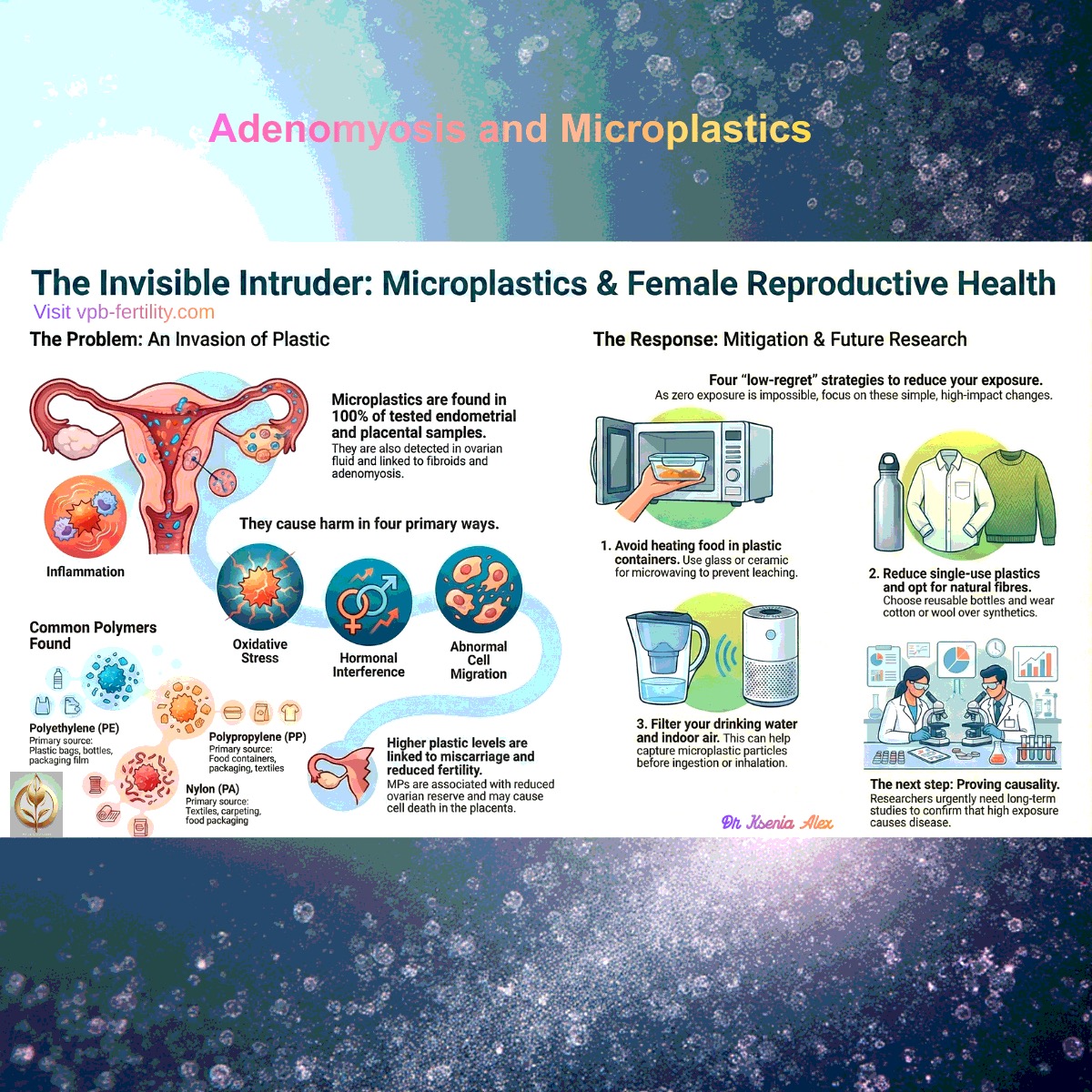
The risk of microplastics to reproductive health is no longer theoretical. Recent studies have physically identified these particles in areas previously thought to be sterile and shielded from such environmental contaminants. The findings are stark: in some studies, microplastics (MPs) have been detected in 100% of endometrial samples analyzed.
Beyond the uterine lining, they have also been found in ovarian follicular fluid, placental tissue, and even in umbilical cords. This confirms that these particles are not only being ingested or inhaled but are capable of traveling through the body and accumulating in the very tissues responsible for creating and sustaining life. The most common types found are Polyethylene (PE) and Polypropylene (PP)—the very same materials that constitute the majority of global food and beverage packaging, creating a direct link between our daily consumption habits and this internal invasion.

3. Takeaway 2: They're Not Just Passing Through—They Actively Inflict Cellular Damage

These particles are not inert "passengers" simply lodging in tissue. The available evidence shows they are biologically active, capable of inflicting damage on a cellular level through several distinct mechanisms.
  • Chronic Inflammation and Microtrauma: Like tiny splinters, MPs can act as physical irritants that facilitate "microtrauma" at the boundary between the uterine lining and the uterine wall. This can trigger a chronic inflammatory response, which is believed to be a key factor in the development of conditions like adenomyosis.
  • Oxidative Stress: On a microscopic level, MPs have been shown to induce oxidative stress, a process that can damage critical components of our cells, including their energy-producing mitochondria and their DNA. This can lead to premature cellular aging or even cell death.
  • Hormonal Interference: Many plastics act as Endocrine Disrupting Chemicals (EDCs), meaning they can interfere with the body's master hormonal signaling system (the Hypothalamic-Pituitary-Gonadal axis). By disrupting the delicate balance of hormones like estrogen and progesterone, MPs can interfere with processes essential for menstrual health, fertility, and a healthy pregnancy.
  • Cellular Migration: Certain plastics, such as polystyrene, have been shown to promote the migration and proliferation of endometrial cells. This abnormal cell movement is a known hallmark of conditions like endometriosis and adenomyosis, suggesting plastics may actively contribute to their progression.

4. Takeaway 3: A Troubling Link to Miscarriage and Uterine Conditions Is Emerging

While research has not yet proven that microplastics directly cause specific diseases, the association is growing stronger. Studies are consistently finding a correlation between higher concentrations of MPs and negative health outcomes.
For example, higher concentrations of MPs have been measured in uterine tissues affected by adenomyosis, fibroids, and polyps when compared to healthy uterine tissue. Furthermore, researchers have found higher levels of a specific plastic, polystyrene, in the chorionic villi—the functional units of the placenta responsible for nutrient exchange—of women who have experienced unexplained recurrent miscarriage. It's crucial to note that this evidence is currently "cross-sectional," meaning it provides a snapshot in time. Scientists can reasonably treat this link as a "hypothesis-level rather than established causality" for now, but the pattern is concerning.

5. Takeaway 4: They Can Cross the Placental Barrier and Threaten the Fetus

Perhaps one of the most sobering findings is that microplastics can breach the placental barrier, a protective membrane that is supposed to shield a fetus from toxins and other threats. This confirms that a mother's exposure can become the fetus's exposure.
Once across this barrier, MPs may pose a direct risk to the pregnancy itself. Research indicates that the presence of microplastics can trigger apoptosis—a form of programmed cell death—in the cells of the placenta. The death of these critical cells can impair the development of the blood vessels needed to nourish the fetus, potentially leading to impaired fetal development or even pregnancy loss.

6. Takeaway 5: You Can't Achieve Zero Exposure, But "Low-Regret" Steps Can Help

Given how pervasive plastics are in our air, water, and food, achieving zero exposure is not a realistic goal. However, this doesn't mean we are powerless. Researchers recommend several "low-regret" strategies—simple, common-sense actions that can reduce your overall plastic burden without significant cost or disruption.
  • Avoid heating food in plastic containers. Microwaving or heating can cause chemicals and particles to leach from the plastic into your food.
  • Reduce the use of single-use plastics. Opt for reusable water bottles, coffee cups, and shopping bags to cut down on your primary exposure.
  • Consider filtering indoor air and drinking water. Air purifiers and water filters can capture microplastic particles before you inhale or ingest them.
  • Choose natural fibers over synthetic ones. Clothing made from synthetic materials like polyester and nylon sheds plastic microfibers. Choosing cotton, wool, or other natural fibers can reduce this source of exposure.

7. Conclusion: The Question We Can No Longer Ignore

The evidence connecting microplastics to harm within the female reproductive system is accumulating at a rapid pace. What was once an environmental concern has become a deeply personal health issue. We now know that these particles are not just in our oceans, but in our wombs, our placentas, and our bodies.
While science has yet to draw a definitive line of cause-and-effect for specific diseases, the strong associations and clear biological mechanisms of damage demand our attention. The presence of these particles in the most fundamental tissues for human reproduction marks a critical turning point. As we uncover more about this invisible invasion, the urgent question becomes: what will it take to protect the health of future generations from the consequences of our plastic world?